This "New" Snow White
Jun. 8th, 2025 09:37 am![[personal profile]](https://www.dreamwidth.org/img/silk/identity/user.png) apachefirecat
apachefirecat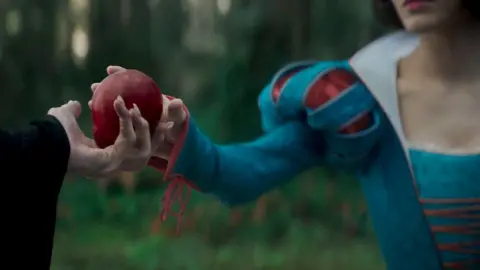
Walt Disney himself was sold on the story of Snow White and the seven dwarfs. To persuade Roy that it was worthy of the fortune that must be expended to produce it and to awaken the enthusiasm of his co-workers to give their best was another matter. Walt was of the opinion that the story had everything. It had romance, a Prince and a Girl. It had plot, a wicked old witch for a heavy. And it had sympathy all the way through. Back in Kansas City in 1914 he had won a free ticket on his paper route to see Marguerite Clark in the picture. The cartoon version could be made an artistic success. He decided to produce it and to direct it himself.
He once said, "I don't think anything without heart is good or that it will last. To me humor involves both laughter and tears. I had both in Snow White. You feel sorry for her at times and for the dwarfs too."
The story was an old folk tale, well known, but Walt Disney did wondrous things to the old plot -- while preserving the original story. All Walt's technicians, musicians, and background experts worked on the film. The original story had no music. Yet the songs in Snow White became known the world over. Audiences hummed the tunes as they left the theaters.
Especially loved were: "Heigh-ho, Heigh-ho, It's Off to Work We Go", "Someday My Prince Will Come", and "Whistle While You Work". These songs were called "Evergreens" because no time or season made any difference. They kept on living.
The Seven Dwarfs, Walt decided, would have to carry the story since Snow White was charming enough, but she was the usual heroine. The Prince appeared only at the beginning and the end of the story. The stepmother was the regulation fairy tale villainess. But the dwarfs could be made beguiling and memorable. They also had to provide the comedy and they must have individuality.
Nor could the dwarfs be fantasies: they must be made believable. To begin with, Walt decided, they must have names. In an old play version they had been named Blick, Flick, Snick, Plick, Whick, and Quee.
Walt demanded that each dwarf possess a sharply-defined personality indicated by a fitting name. He specified that one of the dwarfs must be a sort of boss. Out of the hundreds of names suggested the seven were finally chosen: Grumpy, Happy, Sleepy, Sneezy, Bashful, Dopey, and Doc. Doc was to be the boss or leader. He was a "know-it-all", self-appointed. He was pompous but bumbling, a mistake-maker but always up front.
Dopey was the most difficult of all. He couldn't be just plain dumb and ineffectual. Finally the story men decided to give him the characteristics and mannerisms of a dog -- with no reflection upon dogdom intended. Just as a dog shakes off a fly, Dopey was able to move one ear independently of the other. When he dreamed, he'd paw with one hand the way a dog does while sleeping. But he had to have an accomplishment, just as a dog does who can do tricks. At the dwarfs' entertainment, he did a gay, slap-happy dance that demanded and deserved cheers.
The various names indicated to the artists the necessary facial expressions. Happy's face was wreathed in smiles. Grumpy scowled. Sleepy was droopy-eyed.
The action was also in keeping with the designated names.
Doc had to have the strutting walk of a leader, whistling and waving a hand like a baton. Grumpy is shown as he turns his head to spit, then goes on with the song. Happy is an audience delight. He walks with a rollicking, rolling motion, but in perfect rhythm. When he comes to a tree stump, he hops merrily over it. Sneezy's nose twitches and he slaps at it. Bashful, dreamy and lovable, takes it easy. Sleepy, even though he drags his feet, keeps pace with the others. Occasionally he misses, but he skips to keep in step with the others. Then he stumbles, but again he catches up.
Besides the decision as to characterizations, Walt faced the problem of voices. This was to be a sound picture, in which voices were of the utmost importance. The voices of the dwarfs would identify them quite as much as their appearance and actions.
Walt Disney fitted them with voices from veteran performers in Hollywood. Billy Gilbert, whose sneezing routine was famous in vaudeville and movies proved to be a natural for Sneezy. Roy Atwell, known on radio for his mixed-up language was called upon to do Doc and then it was decided that Doc should not talk -- that his actions spoke louder than words. Otis Harlan's rich voice became Happy's. Scotty Mattraw made Bashful's pleasant tones. Pinto Colvig did both Grumpy and Sleepy.
The script gave Snow White long scenes with the dwarfs. As she became acquainted with each one separately, so did her onlookers, the audiences.
All the workers at the Disney Studio combined their talents. Behind Walt Disney were many other talented men -- the story man, Al Bertino, the director, Jack Hannah and the layout man, Yale Gracey.
The Princess, as portrayed in the old versions, was merely a pretty girl. Everybody agreed that "a pretty girl is like a melody" but this pretty girl must have more than mere prettiness. She must have character and personality.
Walt began work with Tom Oreb to create a different sort of pretty girl heroine. "We were faced," he said, "with the challenge of finding a girl that was different from Cinderella, Alice, and other heroines." Tom Oreb's concept of the girl was pre-Renaissance. She was to be slim, graceful, and withal possessed of a charming simplicity. Her hair was long but smooth and shining and the folds of her dress were to be vertical to blend with early paintings.
The voice for Snow White was as important as the voices for the seven dwarfs. Walt Disney was anxious to find a young, thrilling voice. Literally dozens of actresses tried out for the part of Snow White. Walt was so fearful that the beauty and personality of a singer might influence him that he had a microphone connected from the sound stage to his office. He could not see the singer. Therefore, he could not be influenced by her appearance. She might look like Snow White without being able to sing or speak like the ideal he had pictured in his mind.
Then one day the miracle happened. A voice sounded over the microphone so pure and liquid that he broke in to shout, "That's the girl. That's Snow White."
Whose voice was it? It was the voice of no less a person than Adriana Caseloth! She had been reared in the operatic tradition and could do birdlike trills in effortless beauty. What a find!
Sterling Holloway was already famous for his bland tones, and he proved a "natural" for the Prince.
Eleanor Audley had become a Disney expert in the roles of villainous females. She had been the wicked stepmother in Cinderella, was to be the evil Maleficent in Sleeping Beauty, and it was only fitting and proper that she should be the wicked queen in Snow White.
"Snow White" ushered in the era of dialogue. So said Walt Disney. No longer was the talk in cartoons limited to simple words and exclamations. No longer could gaga fill the bill. Meanings had to be clear and convincing and whole sentences must be heard and understood.
This tremendous job was called by many other producers "Disney's Folly." Even Walt himself may have been dubious at times as to results. There were three years of meetings, of false starts, and employment of new techniques. Bit by bit the endless work went on.
In 1937, the world acclaimed the magic of "Snow White". It drew more money into the theaters than any motion picture up to that time. Critics attempted to analyze its charm. Some say it lay in the depicting of Snow White, befriended in the forest by animals, that set the mood of the idyllic scenes to follow. Others declared its charm lay in the realistic movements of the animals even though they were drawn as cartoons. Still others were thrilled over the portraiture of the wicked queen who concocted a witches' brew to create a poison apple with which to trap Snow White. Scenes of terror gave dramatic contrast to the dwarfs' comedy. Many agreed that the charm lay in the contrasts.
Walt himself probably explained it best when he said, "I look for a story with heart. It should be a simple story with characters the audience can really care about. They've got to have a rooting interest."
"Snow White and the Seven Dwarfs," began in 1934, reached the theaters in 1937. In 1938 it received a Special Academy Award, the same year that "Ferdinand, the Bull" was chosen as the best cartoon of the year.
Walt said, "Snow White and the Seven Dwarfs will be reissued every seven years to new crops of youngsters. It is timeless."
The animator had the task of making jewels sparkle, soap bubble and horror effects where poison was concerned, but the biggest task was a dialogue. Ollie Johnston said, "It is no longer a matter of opening and closing the mouth. You have to consider the personality, the mood, and the action to accompany the meaning."
It is the story d department that must originate the dialogue. Walt always advised his writers that dialogue by kept to a minimum but full of meaning.
After an actor or actress is chosen for a part, he or she is given a thorough rundown on the scene from the storyboards. And this is true whether the performer is to be just a voice or appear in person. Proper instructions puts him in a good mood for the interpreting of his part.
The dialogue must be fitted in properly, often a tedious process. A phonograph record of the dialogue goes to the animation department. The performer also gets an exposure sheet on which is a recording of the scene by the cutter. The exact number of frames for each syllable is given and the cutter points out where the accent belongs.
Walt Disney said, "In a closeup, the audience watches the character's eyes, not his mouth. So we try to do things with the eyes and the rest of the face as well as with the mouth."
"For instance," he said, "you get an idea and your eyes begin to widen. Your pupils move to the middle of your eyes. Your cheeks start to come up. Your whole face moves . . . If you get a bad idea, your eyes narrow, your brow comes down, the corners of your mouth lift."
The mechanics of mouth movement became an increasing problem in the Disney Studios. It was easy enough when animators were dealing with animals like Dumbo and Jiminy Cricket. But the use of human figures like Snow White and the Prince called for precise mouthin.
Merely reproducing lip movement was not enough. Walt reminded his animators that this sort of thing could result in seeming chatter. The drawings must be modified to fit the scene and character. In "Snow White", the heroine talks with each drawf as an individual. The conversation must therefore have variety.
How do animators achieve naturalness? They gaze into mirrors to get results. Some words are more difficult than others. They find the closed-mouth letters, MPB, easiest, as they offer contrast to the rest of the speech. F is difficult because the top teeth over the lip can appear humorous when it is not meant to be.
The animation of dialogue in "Snow White and the Seven Dwarfs" was one of the most difficult tasks that the Disney Studios ever tackled. But Walt agreed that his animators did a perfect job.
The action could have been that of stock characters in ordinary scenes. But Walt Disney put personality and humor in every bit of drama. For example, when the dwarfs have a pillow fight, Dopey ends up with a single feather. Remember, asks Walt, how he puffed it out and lay down with it under his head? It was funny, but it was more. It was Walt's way of expressing what kind of character Dopey was. It created audience sympathy for him.
"Snow White and the Seven Dwarfs" cost one and one-half million dollars.
The bankers became restive when Walt needed that last quarter of a million to finish the picture. The banker and Walt did not see eye to eye. It was reported that Walt followed the banker to his car after a conference "like a puppy dog," Walt said.
At the last moment the banker said, "Walt, so long. You'll make a pot of money on that picture."
So Walt got the loan. And it was not so much later when he was able to say, "I did make a pot of money on that picture."
| Walt Disney: Master of Fantasy By Mildred Houghton Comfort |
 |
In conclusion... Snow White does NOT need to be redone! It is NOT against women, and A LOT of love, hard work, inspiration, and belief went into the first movie. It is a piece of the Mouse legend, an integral and important piece. And Walt, I honestly believe, along with the others who poured so much love, dedication, imagination, creativity, and pure, hard work into the first film, would be rolling in the graves to see what they've tried to make it!


